Exercise: 30 Min of Ice Skating practice, 3x5 Over Head Squats (155, 175, 185, 185x, 185x), then: 5 Cleans (205#) 5 Muscle ups, 4/10, 3/15, 2/20, 1/25: {25:41}
Food: Breakfast - 4 Sausages, Lunch - 1 cheese quesadilla, Dinner - 8 oz steak, 1 cup salad (vinegar and oil) and 1/2 cup rice.
Liquids: 3 cups of coffee, heavy cream, 16oz of water, 2/3 H2o power drink.
Vocabulary for the Olympic Lifts:
Some of us have been reading the CrossFit main site and said once or twice, "What the fuck!?! Is it a Clean or a Squat Clean?" Well, I am here to "clean" up all the mess of confusion to make your CrossFitting experience that much more understandable. First of all, the word (Squat Clean) is a more simple way that CrossFit uses to describe the receiving position in the specific exercise. It's much easier to explain so people stop freaking out and blowing up the blog asking, "Do I catch in a full or partial squat?".
I am a traditionalist and I do as the workout says. If I see only the word Clean or Snatch, you can bet your fanny that I will be dropping in the full squat to receive that bar, unless stated otherwise.
I'm going to kick it off starting the bar from the Hip down to the floor:
Hang (1): The beginning of the lift begins in the High Hang Position (the hip) down to the top of the knee caps, maintaining straight arms.
Power (2): This is the position that you will receive the bar. Whether the bar starts from the ground or the high hang, the power position will be caught in a partial squat. The Power position can be received anywhere between a slight bent hip all the way to a parallel squat (the hip will not pass the knee caps in the squat).
Muscle (3): This movement has the most power exerted from the hip out of the triple extension to bring the bar to any receiving position without squatting. A Muscle Clean starts from the floor and is jumped up into the front rack position. There is ZERO bending of the hip to receive the bar once it has passed the pockets of your pants and have come to full extension with the body.
Clean/Snatch (4 and 5): These are considered full movements. You will start from the floor bringing the bar to a maximum height. Then, receiving the bar in the full squat with a Front Rack or Over Head catch depending on the type of lift and returning it back up to a full standing position. **Remember, if you add an additional exercise before it, you will only catch in the full squat position. The name(s) before the exercise will dictate the bars starting and receiving positions.
Mix and Match:
I will state the numbers and you will add the word that is next to it with a starting and ending point. I would go over back and refer to the definitions and read the meaning of them to truly understand how these exercises would be performed. Example: 1/4 =? Hang Clean [starts at the hip and ends in the full squat catching in the clean or front rack position].
#1. (1/2/4)
#2. (2/5)
#3. (3/4)
#4. (3/5)
#5. (2/4)
#6. (1/2/5)
Post your answers to the comments and leave your name. Good Luck!!
Food: Breakfast - 2 full eggs, 2 oz of cheese, 3 1/2 strips of bacon.
Liquids: 4 cups of coffee w/ 1/2" of heavy cream, 8 oz of water.
Topic of the Day:
Most of you would like to know what are some of the Mechanics to Olympic lifting and the drills. This is going to be a loooooong post, but I think we can manage with touching on some of the drills.
Before you start any olympic lift, it is wise to use the Burgener warm up. This is a drill that we use in CrossFit to help prepare and dial in the transitional movements of the olympic lifts. The Burgener warm up can be used for the Snatchor the Clean, depending on what movement you are going to attempt. Always remember that you must hang on the pipe or bar with the (Hook Grip). The Hook Grip is the most powerful grip that you have while doing the oly lifts. However, you must know your releasing points of the thumb during the lift so you do not limit Range of Motion (ROM) in the arms.
The Hook Grip is obtained by having a full grip on the barbell. Releasing your index and middle finger, cover the nail of the thumb with both the index and middle finger, still hanging on to the barbell. If you do not have a barbell at the moment, you can try it while sitting at your computer. Clench and ball up your fist as if you were squeezing all you fingers into your palm (or if you simulated punching something). Once you have done that, release the middle and index and cover the nail of the thumb. That is the Hook Grip.
I will go over the Burgner Warm up in the Snatch grip first:
Stance - Feet directly under the hips (8-12" apart) in a neutral position; also called the Jumping Position.
Grip - With straight arms, do PVC PassThrough's from the front of the belly button to the low back to find the sticking point. The sticking point is the point to where you have no more range of motion in the shoulders to keep the elbows straight. Pass Throughs must be started in a wider grip, pushing the bar away from the body without bending the elbows EVER! While pushing the bar away, trace a large circle from the front of the body, over the head to the low back. Again, do not ever bend the elbows. Slowly inch in closer every so often to find your snatch grip and that sticky point.
Pass Through's not only are a way to find your sticky point (which is where your Snatch Grip will reside), but it is a great warm up to open the shoulder gurdle. Keep the bar 8-12" above the head.
Action: All Movements x3 or x5 depending on your warmth. (Refer back to the video called Burgener Warm Up and watch closely to the movements.)
Shoulder Shrugs - Stand tall and with straight arms in the hang position, dip 2-3" then, as you jump coming out of the dip, shrug your sholders into your ears. Always keep the bar attached to the body (actively pull the bar into your legs) and never bend the elbows. Don't let the chest fall forward at any point of the warm up or allow the back to round. All movements are to be performed quickly.
Elbows High and Outside - Dip/jump, Shoulder Shrug then pull the elbows high into the ceiling looking like a scarecrow. Return the bar once it has reached max height but not passing the chin. (Do not pull the bar and elbows before the Shrug. Allow the legs and hips to get to full extension then execute the high pull.)
Muscle Snatch - Dip/Jump, Shoulder Shrug, Elbows high, then external rotation of the bar, catching the bar directly over head with the elbows locked out. Keep a constant upward pressure on the bar to maintain a center balance over the middle of the foot. **(DO NOT rebend the knee when catching over head after the external roatation.) That is called a Hang Power Snatch and will be touched on shortly.
Quarter Drops - With the feet under the hips and bar fully pressed over head, quickly pull your feet up and drop in the quarter squat only 2-3" deep. In the quarter squat, your feet should move from 8-12" to 12-15" approximately, in the final landing position. Stand back up out of the quarter squat with the weight still over head and reset the feet back under the hips.
Full Drops (optional depending on movement) - Start in jumping position again, execute same as the Quarter Drops, instead this time drop futher down into the full squat (hip below the knee caps) and move the feet a tad wider by and inch or two.
Hang Power Snatch - Dip/Jump, shrug, elbows high, external rotation + quarter drop simultaneously. Stand up to the full extended position with the bar over head. Do not drop the bar until you have completed the full movement and reset the feet directly under the hips.
Hang Snatch - Same as HPS but instead of the quarter drop, get into the full squat position with the hip below the knees.
** The Clean will be the exact same movements and progressions. The only thing that will change is instead of catching over head on the Muscle, catch in the Front Rack Position and the bar will rest on the shoulders under the chin with the Elbows high facing the wall.
Faults in the lift - When doing oly lifts, if not under the vue of a knowlegable coach, you will sometimes find these faults while lifting. So, if you are a garage warrior it would be a wise idea to record yourself with a camera to see and disect your lift.
1. Core to extremity violations: Pulling with the arms early before the knees and hips come to full extension. Your legs and hips are the power source of all lifting movements, and the arms should not be used as primary movers.
2. Toe Push: A lot of the time, people feel that lifters press out of the toes and have a frontal plane pressure on the ball of the foot only. To one is there own, but I coach the lifts by floating the toes and maintaining contact to the floor with the balls of the foot and the heel. Think of pressing out of the arch of the foot.
3. Hip kick or bounce: Once you have reached the jumping position or when the bar hits your pockets, some people kick the bar out and have it "Rainbow" around the body rather than pulling it straight up. Think of pulling the bar up the body and lifting the shirt up!
4. Frontal Lean: Keep the weight loaded in the heels when executing your lift. Avoid any pressure on the toes because it will eventually lead to a missed lift, due to a further pull away from the body.
I have started my days of physical activity again. I'm finally recovered from my cold, and I have picked up a new sport. I'm starting to do Hockey training and it really is a challenge.
Exercise: 45 min on a Ice Skating Treadmill, 2 hours of rest, then: 4 Rounds of 400 M run, 15 Hand Stand Push Ups and 15 Pull Ups.
Been down with the Flu since monday the 21st of December. I have not worked out in 9 days and have not been the best example of proper eating habits due to the Christmas Holiday. Should be back on track for Monday. Hopefully...
How a virus Works:
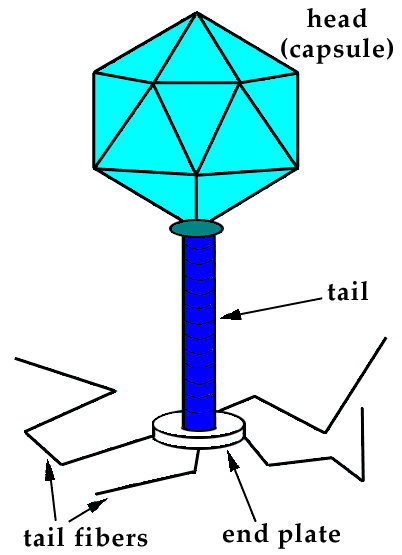
In 1898, Friedrich Loeffler and Paul Frosch found evidence that the cause of foot-and-mouth disease in livestock was an infectious particle smaller than any bacteria. This was the first clue to the nature of viruses, genetic entities that lie somewhere in the grey area between living and non-living states. Viruses depend on the host cells that they infect to reproduce. When found outside of host cells, viruses exist as a protein coat or capsid, sometimes enclosed within a membrane. The capsid encloses either DNA or RNA which codes for the virus elements. While in this form outside the cell, the virus is metabollically inert; examples of such forms are pictured below. In 1898, Friedrich Loeffler and Paul Frosch found evidence that the cause of foot-and-mouth disease in livestock was an infectious particle smaller than any bacteria. This was the first clue to the nature of viruses, genetic entities that lie somewhere in the grey area between living and non-living states. Viruses depend on the host cells that they infect to reproduce. When found outside of host cells, viruses exist as a protein coat or capsid, sometimes enclosed within a membrane. The capsid encloses either DNA or RNA which codes for the virus elements. While in this form outside the cell, the virus is metabollically inert; examples of such forms are pictured below. When it comes into contact with a host cell, a virus can insert its genetic material into its host, literally taking over the host's functions. An infected cell produces more viral protein and genetic material instead of its usual products. Some viruses may remain dormant inside host cells for long periods, causing no obvious change in their host cells (a stage known as the lysogenic phase). But when a dormant virus is stimulated, it enters the lytic phase: new viruses are formed, self-assemble, and burst out of the host cell, killing the cell and going on to infect other cells. The diagram below at right shows a virus that attacks bacteria, known as the lambda bacteriophage, which measures roughly 200 nanometers. Viruses cause a number of diseases in eukaryotes. In humans, smallpox, the common cold, chickenpox, influenza, shingles, herpes, polio, rabies, Ebola, hanta fever, and AIDS are examples of viral diseases. Even some types of cancer -- though definitely not all -- have been linked to viruses. Viruses themselves have no fossil record, but it is quite possible that they have left traces in the history of life. It has been hypothesized that viruses may be responsible for some of the extinctions seen in the fossil record (Emiliani, 1993). It was once thought by some that outbreaks of viral disease might have been responsible for mass extinctions, such as the extinction of the dinosaurs and other life forms. This theory is hard to test but seems unlikely, since a given virus can typically cause disease only in one species or in a group of related species. Even a hypothetical virus that could infect and kill all dinosaurs, 65 million years ago, could not have infected the ammonites or foraminifera that also went extinct at the same time. On the other hand, because viruses can transfer genetic material between different species of host, they are extensively used in genetic engineering. Viruses also carry out natural "genetic engineering": a virus may incorporate some genetic material from its host as it is replicating, and transfer this genetic information to a new host, even to a host unrelated to the previous host. This is known as transduction, and in some cases it may serve as a means of evolutionary change -- although it is not clear how important an evolutionary mechanism transduction actually is.
Cardiovascular/ Respiritory Endurance- The ability of body systems to gather , process and deliver oxygen.
Stamina- The ability of body systems to process, deliver, store, and utilize energy.
Strength- The ability of a muscular unit, or combination of muscular units, to apply force.
Flexibility- The ability to maximize the range of motion at a given joint.
Power- The ability of a muscular unit, or combination of muscular units, to deliver maximum force in minimum time.
Speed- The ability to minimize the time cycle of a repeated movement .
Coordination- The ability to combine several distinct movement patterns into a singular distinct movement.
Agility- The ability to minimize transition time from one movement pattern to another.
Balance- The ability to control the placement of the body's center of gravity in relation to its support base.
Accuracy- The ability to control movement at a given direction or at a given intensity.
The ten general physical skills list that CrossFit follows were determined by Jim Crawley and Bruce Evans, founders of Dynamax (those med balls that we like to use) and two legit track and field coaches. You may not agree with the list, but take a good look at it. I think it definitely defines the skill set of elite CrossFitters.
Welcome to CrossFit 949. For quick contact information, you may call or email at any time! Our operating hours are M-F 6a - 7p and Saturday at 9a only.
Train hard!
CrossFit 949
949-667-3717